Where and when did skateboarding start?
Skateboarding originated in California during the 1950s. Surfers and kids who wanted to do something as close to surfing as possible when the swell was low began to chop up old roller skates, take the undercarriage and then create a wooden ‘deck’ to place on top. Creating the first version of the skateboard. During this time, the shape of the deck meant nothing; often these decks were made from offcuts of wood, and that was enough. These first-edition skateboards were designed to be ‘surfed’ around the streets - carving and cruising the sidewalks. As it grew – and surfers really leaned into it, skateboard decks began to take more of an obvious shape during the ‘60s. The ‘anything goes’ approach slowly crept out, and the desire to make decks imitate the shape of surfboards began to become the norm.
A brief history of skateboard decks
The late 60s and 1970s
After the initial boom of this version of skating, trick progression was limited and pretty stagnant, to be honest. People were tired of watching hippies riding around doing handstands on their boards, and the ‘fad’ of skateboarding slowly began to die out. However, by 1969, a man named Larry Stevens invented the kicktail skateboard deck, effectively taking the current ‘surf’ shape and lifting the tail up for increased control and manoeuvrability. A shape that’s not too dissimilar from decks you would see in freestyle skating to this day, mainly because freestyle skating is well and truly stuck in the ’70s and the '80s.
Freestyle skating was never going to save skating during this time. Don’t get me wrong, there is no denying that freestyle skating transforms skating later down the line, but during the ‘70s, skateboarding needed the likes of Tony Alva and Jay Adams. The Zephyr Crew, aka the Z-Boys (with the help of polyurethane wheels), saw the corny nature of freestyle skating at the time and decided to turn it completely on its head.
Going back to the roots of skateboarding, the Z-Boys re-established the ‘f*ck you’ surfer attitude. A great example of this is the 1975 Del Mar Nationals. No handstands, no dancing, just aggression. Tight turns, low stance and the introduction of ‘style’. “What has this got to do with decks?” I hear you cry. Well, in 1975, the Z-Boys not only shook up the competition scene but also introduced a whole new style of skateboarding. Pool Skating.
During the Californian drought of 1975, many, if not all, pools in California were drained, leaving what can only be described as concrete waves. Skating these pools, to rip them as aggressively as possible, resulted in boards becoming far wider. In fact, by the late ‘70s, Alva was releasing 10” decks! Not only that, replications of the transition within pools were being replicated and made for skateparks and backyards all over, igniting the origins of vert skating.
Although the progression of skateboarding at the time was seemingly limitless, skateboarding was about to enter another lull. The huge boost pool skating brought to the scene, with commercial skateparks popping up all over the place in the ‘70s, began to turn sour as skateboarding progressed, and so did the dangers. Ultimately, scaring away many potential investors and causing many of these newly made skateparks to quickly vanish. However, the few skateparks that remained, as well as the homemade DIY ramps built, created a melting pot of dedicated enthusiasts who kept the spirit well and truly alive.
The 1980s boom, anything goes!
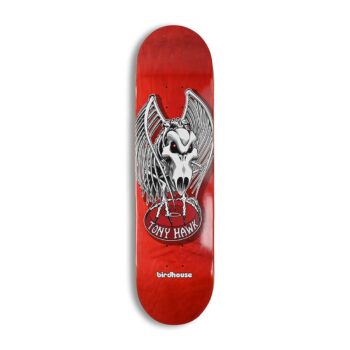
Eventually, out of the dark came a massive beacon of light, a video named The Bones Brigade, released in 1984 by Powell Peralta. The Bones Brigade reminded everyone why skateboarding was so sick, with the likes of Tony Hawk and Lance Mountain blowing minds with the tricks they had created, whilst everyone else was off doing something else. With that, the next five years of skateboard deck design went absolutely bonkers.
When I say it went absolutely bonkers, hardly any of the design changes were technological advances, let alone improvements of the way in which the deck handled the terrain in front of it. No, these decks were still super wide and mostly kept the single kick at the tail – if they did have a kick at the nose, it was incredibly minimal. What made these decks mental were the shapes of the decks themselves. The Vision ‘Psycho Stick’ or the Hosoi ‘Hammerhead’ decks, for example, opened up the world of skating to truly radical shapes and graphics. Everything was fair game; it just needed to have a tail and some width. Skaters around the world were effectively gifted a whole new freedom of picking which deck shape or graphic suited their style the most. This anarchic creativity is something skateboarding holds to this day, with deck graphics and brand aesthetics being arguably one of the most important details behind a deck company.
By the late ‘80s, skating was evolving faster than ever, with street skating becoming a whole new beast. Unlike before, when both street skating and vert skating effectively used the same type of board, the newly introduced technical nature of street skating required a shift away from the single kick board. This is when the merging of street skateboarding and freestyle skateboarding truly took place. Whereas most skaters removed themselves from freestyle skating, some nerd called Rodney Mullen stuck with it, and in doing so, created the foundation of modern street skating as we know it.
The 1990s - skateboard designs mature
The only issue was that he had invented tricks such as the kickflip on freestyle boards, much slimmer and lighter than the boards street skaters were using at the time. Skaters such as Mark Gonzales and Natas Kaupas had really pushed the levels of street skating all the way up to the late ‘80s, but they needed something new to delve into the world of flip tricks and handrails. In walks Chuck Hults, with Mike Vallely’s Barnyard Twin Tail deck, the forebear of all modern double kick decks we know and love today.
This isn’t to say that with a click of some fingers, the popsicle deck was created; in fact, there was a bit of a mix of double kick shapes hanging around in the early ‘90s. Ed Templeton’s first pro board with New Deal, for example, had a more traditional shape to it, just with a larger kicked nose than seen before. Other skaters were riding ‘football’ shape decks, reminiscent of the ‘egg’ shapes we see today. Similar to the beginning of the vert decks earlier, provided the decks had a kicked nose and a tail, it was pretty much down to personal preference as to which one you would be skating. It wasn’t until the mid-'90s that the popsicle deck truly took its place as the skateboard deck shape.
You may be thinking, Ah well, that’s that then. The popsicle was made, and here we are 30 years later, with no real difference made. And compared to the history before it, you may have a point. But we are here to say otherwise. The ultimate shape for a skateboard deck may have been discovered by the mid-'90s, but now it’s time to get into the nuances of what makes the perfect popsicle. Stay with me, it is more interesting than it sounds, I promise!
The modern popsicle-shaped deck and beyond
From the mid to late ‘90s up until the mid to late ‘00s, popsicle deck sizing mainly ranged from 7.5” to 8.0”, with 7.5” and 7.75” being the main deck sizes used. Technical skating was at its absolute peak during this time, with progressive tricks being rifled off everywhere you look.
When it comes down to this type of skating, especially in its early years, a slimmer board really does help when it comes down to flipping into and out of ledge tricks, for example. However, as time went on and technical tricks were more established, decks throughout the 2010s gradually became wider and wider. Of course, some skaters never moved on from their favourite widths, but as newer generations found their way into skating, and tricks such as a flip bs tail became a pretty obtainable trick (in terms of those progressing skateboarding), the need to have a slim board to make the flip "in" as easy as possible faded away. Generally, decks within the 8” to 8.5” width range emerged.
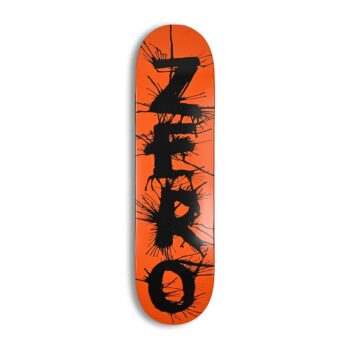
A massive advantage of having a standardised deck shape is that it creates a much easier entry into becoming a deck brand within the industry. With only a handful of deck manufacturers spread across the world, it is much easier to hit order minimums when the main difference between them is the graphics, not the shapes. We’re not for one second claiming that all popsicle decks have the same dimensions, as that couldn’t be further from the truth. Brands such as Chocolate and Girl Skateboards offer a huge range of popsicle decks with various wheelbases, lengths, and concaves. However, returning to the original point, most wood shops have their own in-house shapes, which new brands can use, resulting in an explosion of new brands coming out since the mid-‘90s. Anti-Hero, Zero, Death, Palace, Baker, Polar Skate Co., and Magenta are just a drop in the ocean when looking at the whole list. You really have never had more choices when it comes to the options of board brands available nowadays!
On top of all that, perhaps bored with the monotony of seeing the same shape boards over and over again, brands such as Welcome Skateboards arrived onto the scene in the 2010s, releasing deck shapes similar to the Templeton pro-models of the early ‘90s. These shaped boards were never really going to compete with the popsicle regarding sales, and they certainly aren’t going to be the new norm; however, not every skater wants to emulate Nyjah Huston and would much rather look at a skater such as Chris Milic and delve into the less serious world of creative skating. Shaped boards, for some reason, perhaps their limitations, really do lend themselves to looking at spots differently, thus causing your skating to adapt and getting your creative juices flowing.
A great example of this is the popularity of the Heroin Skateboards egg-shaped boards, mainly designed and used for curb skating. In 2025, they released their 100th egg deck after their first release in 2018. You certainly can’t call it a fad with that kind of continuous appeal!
At the end of the day, board shape and size preference is something only you can really decide on. Everyone here at Supereight has their own ideal shape and size, a preference that has been discovered over time through trying out various options out there. To be honest, some of us even have a few different complete boards to use depending on where and what we are skating. Whatever you do, just know it’s totally down to you! Don’t let other people's deck choices sway yours; everyone’s preferences are different, and only you know what you like most.