Skate Shoes
-
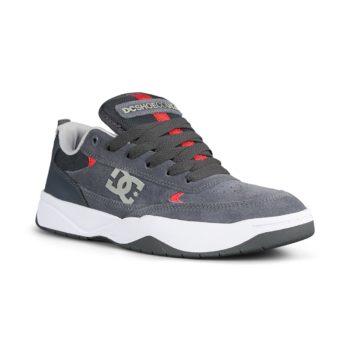
DC Shoes Penza – Grey / Grey / Red
Original price was: £58.99.£29.99Current price is: £29.99. View Product This product has multiple variants. The options may be chosen on the product page
DPD Next Day £1.95 On Orders Over £75
Shop Now
Skateboarding is an incredibly demanding activity for your shoes to endure. When skateboarding first started, skate shoes, as we know them today, did not exist. This resulted in flat-soled shoes such as Vans and Converse All Stars being used frequently, in many cases, no shoes at all!
Many skaters at the very beginning opted to go barefoot, as no boards were equipped with grip tape, and ollies were far from being invented. As skating evolved, so did the shoes. As people started doing large drops, experiencing high impacts and flip tricks came into play, the shoes had to also evolve to match. Style, impact protection, durable materials and comfort became increasingly important, leading us to where we are now.
If you really really want to, you can try and skate in anything you want. Part of the beauty of skating is that there are no rules. However, that is not to say you will have a good time in them. There are trainers out there that may at first glance appear to hold the qualities of a skate shoe, but when you look closer there will be some clear differences.
As mentioned earlier, there was no chicken or egg scenario when it came down to skate shoes vs skateboards. Skateboards were around way before skate shoes. Skateboards were first sold in the 1950's as a toy, something you leave in the garage next to the footballs and pogo-sticks. People mainly skated barefoot or in thin flat-soled shoes such as Keds and Converse in an attempt to maintain as much board-feel as possible. The very first skate shoe didn't appear until 1965. The Randolph Rubber Company released the Randy 720 which was designed to possess tough rubber on the front and back of the shoe, but thin enough to replicate that bare foot feel. Shortly after in 1966, Vans entered the game and gathered a lot of attention at the time with a lot of skaters riding in the Vans "Authentic" or #44 plimsole... But it wasn't until 1976 that Vans created the very first bespoke skate shoe named The Style #95 or as it's known today, the Vans Era.
The Vans Era was designed with help from the godfathers of skateboarding, Tony Alva and Stacey Peralta. Taking the #44 (now known as the Authentic) and adding a padded collar but maintaining the general shape and sole unit as the Authentic. Hardly reinventing the wheel I'll admit, however, the addition of the padded collar was a design feature made exclusively for the benefits of skating, something that had never been done before. Shortly after the Era was released, Vans then released the Style 36 (Old Skool) and the Style 38 (Sk8-Hi), cementing themselves into the skating scene and making it clear they desired to be at the forefront of skate shoe design.
Then, much to the horror of all skate shoes at the time (1978), a man named Allan “Ollie” Gelfand created, yep you guessed it, the Ollie. This was a huge turning point in the world of skate shoes. Before the Ollie, skate shoes just needed to have a flat and grippy sole unit with plenty of board-feel. Now, shoes had to withstand the continuous abrasion of griptape rubbing across the side of the shoe. Durability then became much more of concern for skaters and shoe companies alike.
This necessity of durable uppers brought in a whole new wave of skate shoe aesthetics. High-top silhouettes such as the Sk8-Hi were super dominant. Well, I say super dominant, this was actually the beginning of the '79-'83 'Dark Ages' of skateboarding. At this point in time, skateboarding was a truly tiny scene with only a few people seeing it's potential. This was all until Powell Peralta released The Bones Brigade video in 1984. With dudes like Lance Mountain, Steve Cab and Tony Hawk showing the world how rad skateboarding can be, skateboarding clawed back it's credibility, resulting in droves of kids clambering over each other to get themselves a skateboard. Sort of.
By 1986, both Etnies (originally named Etnics) and Airwalk were founded and gradually began to build a decent following from skaters. However, it must be said that the Nike Air Jordan 1 was one of the most popular shoes of the '80s. For example, when Animal Chin was released in 1987, every single skater in the intro is seen wearing Jordan 1's, all except Tony Hawk who was still loyal to the Vans Sk8-Hi. Nike were still very much disinterested in entering the skating market, but the availability of the Nike's combined with the rugged construction made them last for a decent amount of time. Remember, skating was still at a very basic level in regards to flip tricks, stair sets and most other modern aspects of skateboarding, so kids could get away with the Jordan's without too much hassle.
Before skateboarding blasted it's way into the '90s, both Etnies and Vans introduced the world to the 'pro-shoe'. At the tail end of '87 Etnies released the "NATAS" pro-model for one of the hottest young skateboarders, Natas Kaupas, and then in 1989 Vans released the Caballero. Interestingly, Tony Hawk actually opted out of getting a pro-shoe, as he thought it would come across as 'corny'. The Hawkster obviously realised his mistake later down the line, getting his first pro-shoe through Airwalk, and even accepting sponsorship from McDonalds! Anyway... Street skating was well and truly on course to take over from transitional skating at that point, which of course resulted in the requirements that skate shoes needed to fulfil changing, again.
With street skating beginning to take over as the main discipline of skateboarding, complex flip tricks began to be at the forefront of every kid's mind, something which is quite difficult in a clumpy high-top shoe. Those ankles need to be able to flick! So what did the kids do? They chopped their shoes of course! Kids were taking Vans Caballero and cutting down the high-top sides and wrapping the exposed top with duct tape. All in pursuit of a decent flick on their board! By '92 Vans had clocked onto this and released the Half-Cab, a shoe which every skateboarder at least knows of, if not skated. Now over 30 years old, these are the longest running pro-shoe ever made, with no sign of its popularity slowing down any time soon.
By the mid to late '90s, skateboarding was yet again enjoying another popularity boom. This opened up space for many more skate shoe companies to join the table. In fact, I'd argue that this was the peak era for skate shoe companies, genuine skater-owned skate shoe companies, made for skateboarders. Etnies created Emerica and éS, World Industries started Duffs, Damon Way and Ken Block started DC and Tim Gavin founded DVS. That's no where near where it ends either, Globe, Sheep, Simple, Osiris, Lakai, Axion and Adio were also all brought out in the '90s. Could you imagine that amount of shoe companies coming out nowadays?? Nike also finally attempted to join the skate programme too, but let's not talk about how that went... All I will say is, Bam was on the team and he wore eS Accels with a Nike tick glued to the side...
The race for the most tech shoe slowly began to pick up pace by the tail end of the '90s and the 2000's. With eS dropping the Koston pro-model which had the very first airbag placed in the sole. This all got very much out of hand and ended up gifting the world the Osiris D3. The pinnacle of cramming everything you can into a shoe design and creating an indestructible monstrosity of a skate shoe. God bless Fred Durst for wearing those bad boys for years. Jokes aside, there was also another reason as to why these shoes were becoming so bulky. Skateboarding was just getting super gnarly! Drops, gaps and stairsets were bigger than they had ever been and those slabs of meat needed looking after more than ever. By the early 2000's, everyone was rocking big old shoes. Andrew Reynolds' first pro-shoe for Emerica, the Reynolds 1 was a big boy. Fallen came out in 2003 with a whole catalogue of chunkers too. Supra and Vox joined the fray by this point too, all enjoying a fruitful few years of chunky shoe life.
By the late 2000s/2010s technology had reached a point where shoes didn't need to be the size of a small dog to protect your feet. Insoles had vastly improved and everyone realised that airbags just blow up after a few weeks and are then no buenos. Shoes such as the Dylan Rieder pro model and the Nike SB Janoski (yes, Nike had found a space in skateboarding by this point) were really beginning to steer the ship in a different direction. Bringing simple and slim shoes back to the shelves of all the skate shops.
Currently, the skate shoe market has a much less obvious style preference. With the power of the internet, kids nowadays definitely latch onto a certain style of skateboarding that appeals to them and run with that look. Be it the hesh Anti Hero style, bagged out DC dude or just that Marc Johnson-esque timeless classic style, everything is up for grabs. The baggy, big shoe style is probably the style you will see the most at the moment, but it's all free game really. Just know that the technology in skate shoes nowadays is unbelievably good, but depending on which sort of style skate shoe you go for, it will have it's pros but will also potentially have some cons. Read through the rest of this to help discover which style will most likely be your preference!